
If you do not assign decision rights, AI will.
A quiet thing is happening in the way teams decide. AI has moved from drafting documents to recommending options, and in a growing number of tools it now acts, taking steps inside a defined boundary without waiting for a human to press go. Deloitte's 2026 Global Human Capital Trends research reports that 60 per cent of executives now regularly use AI to support their decisions. That is not a future trend. It is the present operating reality for most leadership teams.
The problem is that most organisations were never clear about decision rights to begin with. Who decides, who is consulted, who merely needs to be informed, and on what basis: these questions are answered loosely in most teams, by habit and hierarchy rather than by design. AI does not tolerate that looseness. As Deloitte's research puts it, most organisations "lack clarity about decision rights, and AI will likely muddy decision rights further." When a recommendation engine, a copilot or an agent is sitting in the decision flow, the absence of an explicit rule does not stay neutral. The system fills the gap. The leadership job that AI just made urgent is to assign the decision rights before the tooling assumes them.
The shift: from drafting to deciding
It helps to see why this is different from earlier waves of office software. A spreadsheet calculated; a person decided. Early generative AI drafted; a person decided. What is changing now is that AI increasingly occupies the space between analysis and action. It does not just produce the inputs to a decision. It proposes the decision, and sometimes takes it.
That movement runs along a ladder. At the lowest rung, AI informs: it gathers, summarises and surfaces, and a human makes the call with better material. One rung up, AI recommends: it proposes a specific option or course of action, and a human approves or rejects it. At the top rung, AI acts within bounds: it executes inside a defined envelope, reorders a queue, drafts and sends a routine response, adjusts a setting, and a human is notified and can reverse it.
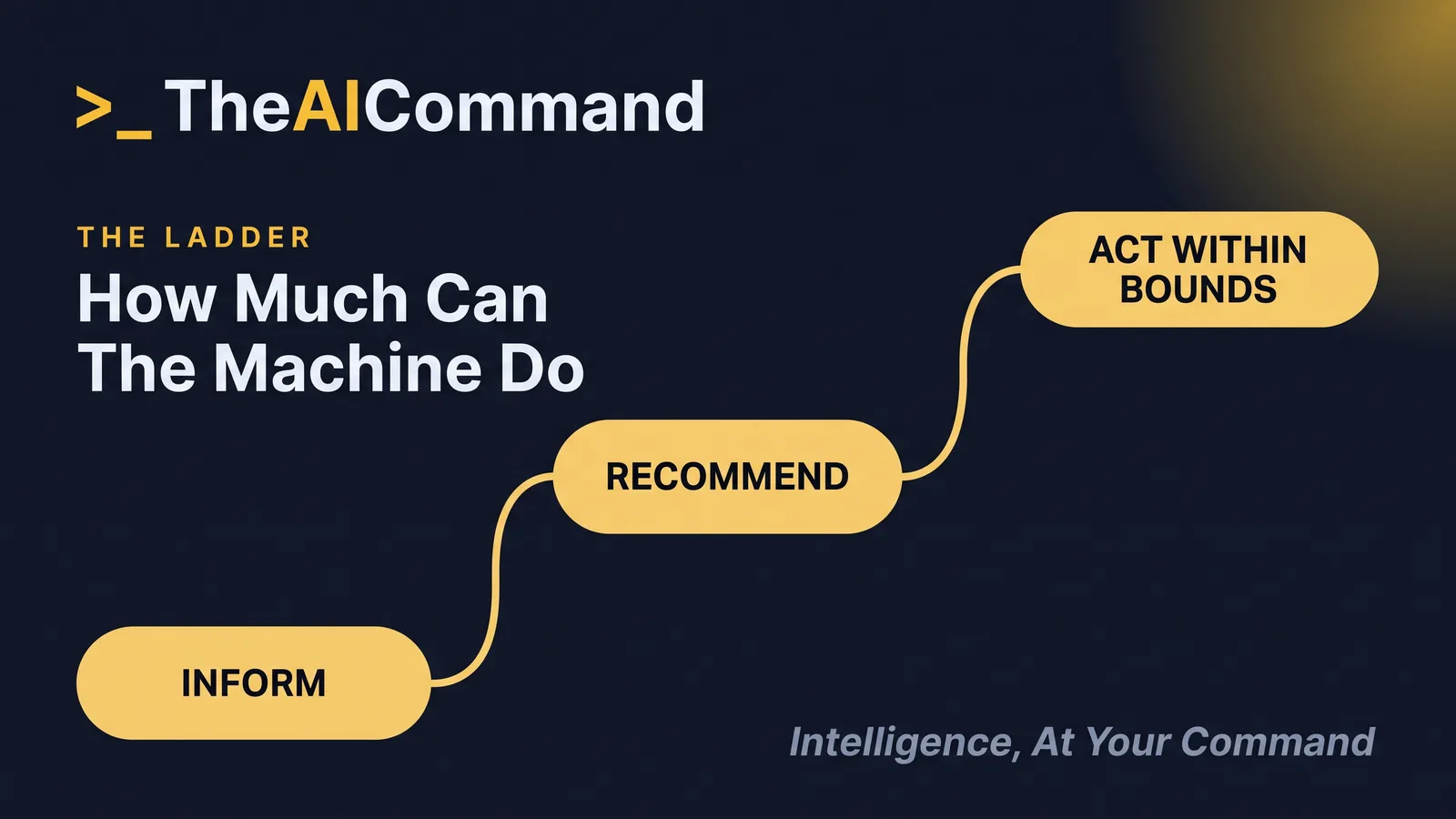
Each rung is legitimate for some decisions and reckless for others. The error leaders make is not choosing the wrong rung. It is failing to choose at all, and letting the default settings of a tool, or the path of least resistance for a busy team, decide which rung applies. A copilot that quietly drafts and the team quietly sends has climbed from informing to acting without anyone deciding it should. The decision right moved, and no leader assigned the move.
Why leaders give the rights away
There is an asymmetry that pushes leaders, often unconsciously, to over-delegate to AI. When a model gets a decision right, the credit tends to flow to the technology and the efficiency. When it gets one wrong, the accountability flows to the manager who let it. That asymmetry, downside on the human, upside on the tool, is exactly the wrong incentive, because it nudges leaders to hand over judgement they should keep and then to look away from the result.
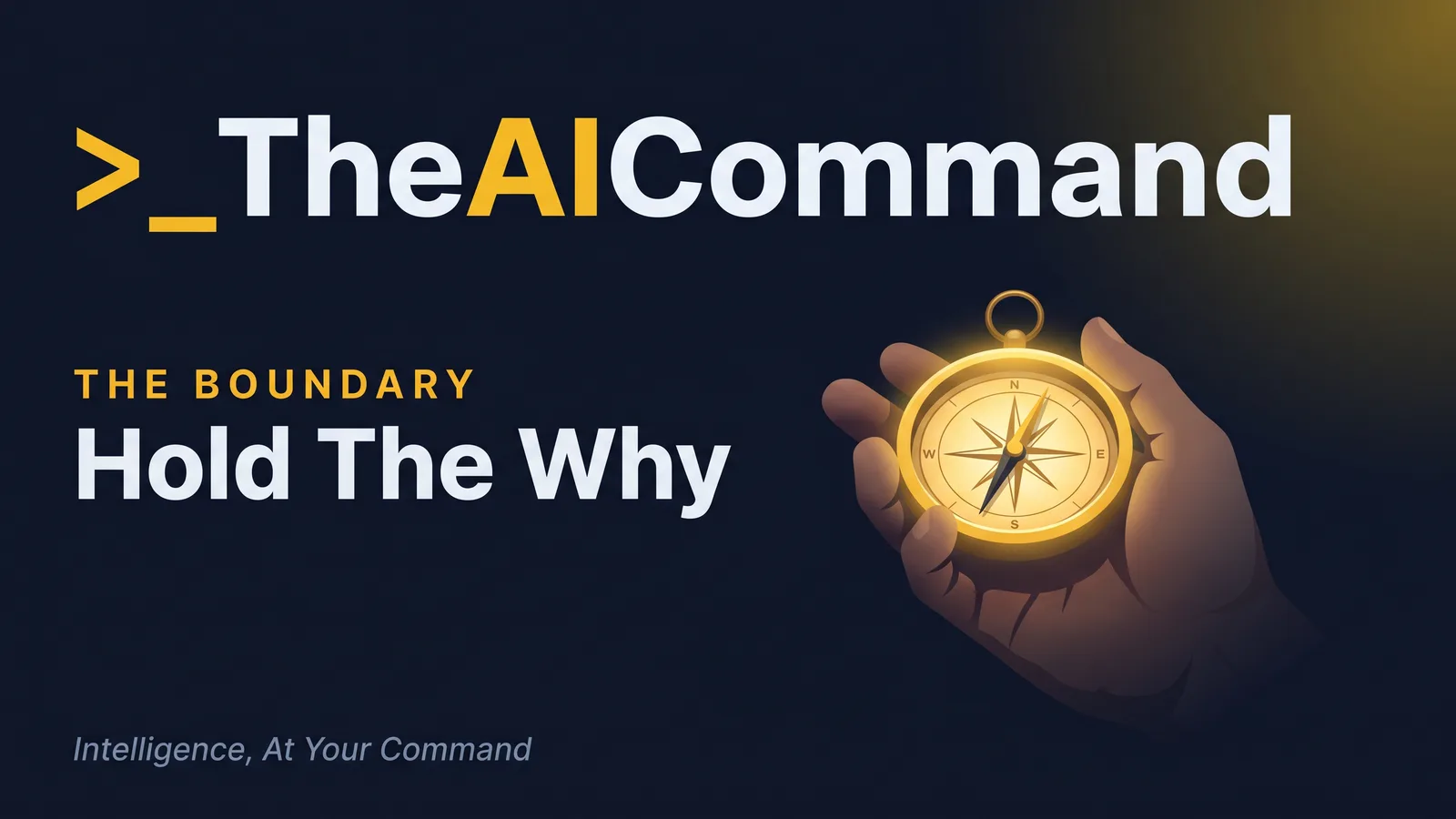
Deloitte's research found that organisations risk "diluting human responsibility when delegating too heavily to AI," and frames the goal as keeping humans "firmly in charge of the 'why.'" The discipline is to delegate the analysis freely and the judgement deliberately. A model can do an enormous amount of the thinking that precedes a decision. The decision about what matters, and why, is the part a leader is paid to own, and the part that carries the accountability when it goes wrong.
This is not a counsel of caution for its own sake. The same research notes that only 5 per cent of organisations consider themselves leaders in AI-supported decision-making, despite 64 per cent calling it very important. The gap is not a technology gap. It is a clarity gap. The organisations that pull ahead will be the ones that decided, on purpose, where AI sits in each decision, rather than the ones that adopted the most tools.
Two ways to get this wrong
There are two ditches on this road, and a decision-rights map is the thing that keeps a team out of both.
The first ditch is over-trust. A leader, busy and impressed by a capable tool, lets AI climb the ladder unchecked. Recommendations become decisions because nobody pushes back. Acting-within-bounds quietly widens until the bounds are gone. The team stops asking whether the model is right because the model is confident, and confident output reads as correct output even when it is not. The accountability still sits with the leader; the judgement has drifted to the machine.
The second ditch is under-use, and it is just as costly. A leader, wary of the risk, keeps everything at inform and treats every AI suggestion as something to be redone by hand. The team carries the analysis burden AI could have lifted, moves slower than its competitors, and the leader mistakes that drag for prudence. The research showing most organisations stuck well short of leading on AI decision-making describes this ditch as much as the first.
The map is the steering between them. By forcing a deliberate choice of rung for each decision, it stops the unconscious climb into over-trust and the blanket retreat into under-use. Each decision gets the level of machine involvement it actually warrants, and the leader can say why.
The operating move: map your decision rights
Here is a method a leader can run with their team this week. It is deliberately low-tech, because the point is the clarity, not the artefact.
1. List your team's recurring decisions. Not the once-a-year strategy calls, but the decisions that repeat: approvals, prioritisations, customer responses, resource allocations, escalations, the routine judgements that fill a week. Most teams have somewhere between ten and thirty of these. Write them down.
2. Assign the decision right for each. For every recurring decision, name who decides. Be specific. "The team" is not an owner; a role is. This is the step most teams have never actually done, and doing it surfaces disagreements that were always there and never voiced.
3. Place AI on the ladder. For each decision, decide which rung AI occupies: inform, recommend, or act within bounds. A high-stakes, low-frequency decision with irreversible consequences probably keeps AI at inform. A low-stakes, high-frequency, easily reversible decision is a candidate for act within bounds. Make this an explicit choice, not a default.
4. Engineer the override and escalation paths. For anything where AI recommends or acts, define how a human overrides it and when it must escalate to a person. Deloitte's research is direct on this, recommending that organisations modernise decision rights "incorporating override privileges and escalation paths engineered into systems so humans and agents coordinate who decides, when, and on what basis." An act-within-bounds decision needs a visible reversal path and a clear trigger that bumps it up to a human. Without those, "within bounds" has no bounds.
5. Write it down and revisit it. Capture the map in one page. Share it openly with the team, because decision rights only work when everyone can see them, and people make better calls when they know exactly which decisions are theirs and where the machine fits. Treat it as a living document, because the right rung for a decision will change as the tools and the team's confidence change. A decision you keep at inform today may move to recommend in three months once you trust the model on it, and one you trusted to act may move back down after a near miss. The map is not a one-time exercise. It is the running record of how your team decides in a world where the machine is always offering to decide for you.
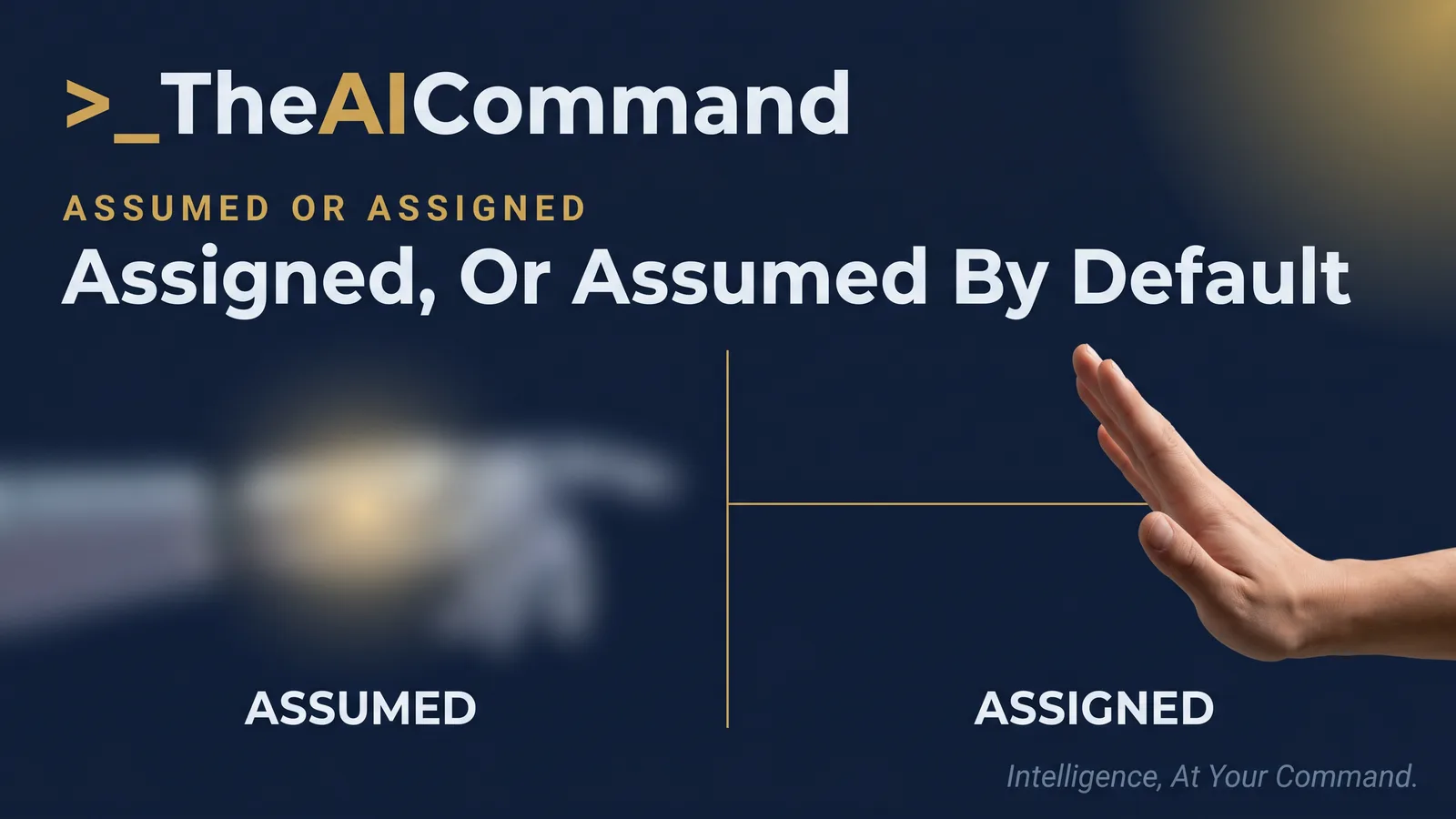
The output is not bureaucracy. It is a shared, explicit answer to a question every AI-enabled team is now answering implicitly: who decides, with what help from the machine, and how a human steps back in. Teams that leave it implicit are not avoiding the decision. They are letting the tool's defaults make it.
The judgement boundary
Mapping decision rights does not mean keeping every decision human. It means being deliberate about which ones are, and that requires naming what AI cannot own no matter how capable it becomes.
AI cannot own the "why." It can optimise toward a goal, but the choice of goal, the weighing of values, the judgement about what the organisation is for, sits with people. A model can tell you the fastest route; it cannot tell you whether speed is what matters here.
AI cannot own accountability. When a decision affects a person's livelihood, a customer's wellbeing or the organisation's integrity, a named human has to be answerable for it. That is not a technical limitation that better models will remove. It is what accountability means. The current generation of agentic systems also remains, in the assessment of MIT Sloan's review of the year ahead, not fully production-ready, prone to hallucination and security weakness, which is a practical reason to keep consequential decisions firmly on the human rungs for now.
And AI cannot own the decisions that define the culture. How people are treated, who is trusted with what, where the lines are: a team reads these from the decisions its leader keeps, not from the ones the leader automates. A leader who delegates the human decisions to a model is not being efficient. They are telling the team that judgement is not their job, and the team will believe them.
A worked example
Take [TEAMLEAD], who runs a service team of twelve. Working through the recurring decisions, they map most of them quickly. Routine customer replies move to act within bounds: AI drafts and sends inside a tight template, with anything outside the template escalating to a person, and any customer who pushes back routed straight to a human. Prioritising the daily work queue moves to recommend: AI proposes an order each morning, [TEAMLEAD] or a senior team member approves it in two minutes. But decisions about a struggling team member, [EMPLOYEENAME], stay firmly at inform: AI can summarise the relevant information, and the judgement about how to support that person never leaves a human. The map takes an afternoon to build and a fortnight to settle. What it gives [TEAMLEAD] is not control for its own sake. It is the ability to say, for any decision on the team, exactly who decides and what the machine is allowed to do, which is the thing that was always vague and that AI would otherwise have quietly resolved on its own terms.
That is the leadership work this moment asks for. Not more tools, and not blanket caution. A clear, deliberate answer to who decides, kept under review, with the "why" held by people. Assign the decision rights, or the system will.
TheAICommand. Intelligence, At Your Command.