
On-device AI is real for a narrow set of jobs. The demos oversell it.
Apple Intelligence shipped its enterprise-ready release in iOS 19.4 on 14 April 2026 with full mobile device management (MDM) controls and explicit data-handling commitments (Apple Enterprise Newsroom, accessed April 2026). Google's Pixel 9 and 10 series with Gemini Nano 2.0 received their own enterprise framing in March 2026 with Workspace integration and Android Enterprise controls (Google Workspace blog, accessed April 2026). Both vendors are positioning on-device AI as the privacy-first answer for regulated workplaces.
The framing is right in narrow ways and oversold in others.
The headline finding
Apple Intelligence and Pixel Gemini Nano are now genuinely enterprise-deployable for specific workflows. Both have real privacy advantages. Neither is a substitute for frontier cloud models on most knowledge-work tasks.
Context
On-device models are smaller than cloud models by design. Apple's on-device foundation model is roughly 3 billion parameters; Gemini Nano 2.0 is around 4 billion. Frontier cloud models are 100 to 1000 times larger. The capability gap is real and unavoidable.
What changed in 2026 is the supporting infrastructure. Apple shipped Private Cloud Compute, an architecture that escalates harder queries to Apple-controlled cloud servers with cryptographic guarantees that data is not retained or used for training (Apple Security Research, accessed April 2026). Google shipped equivalent on-device-first routing for Pixel devices with explicit MDM controls that let enterprises enforce on-device-only mode.
The result is a tiered architecture: easy stuff on-device, hard stuff in vendor-controlled cloud, sensitive workloads pinned to on-device only.
Why it matters
For most knowledge workers most of the time, on-device AI is not the right tool. It cannot draft a 2,000-word brief that holds together. It cannot reason about a complex legal clause. It cannot replace a Claude or GPT-5 workflow.
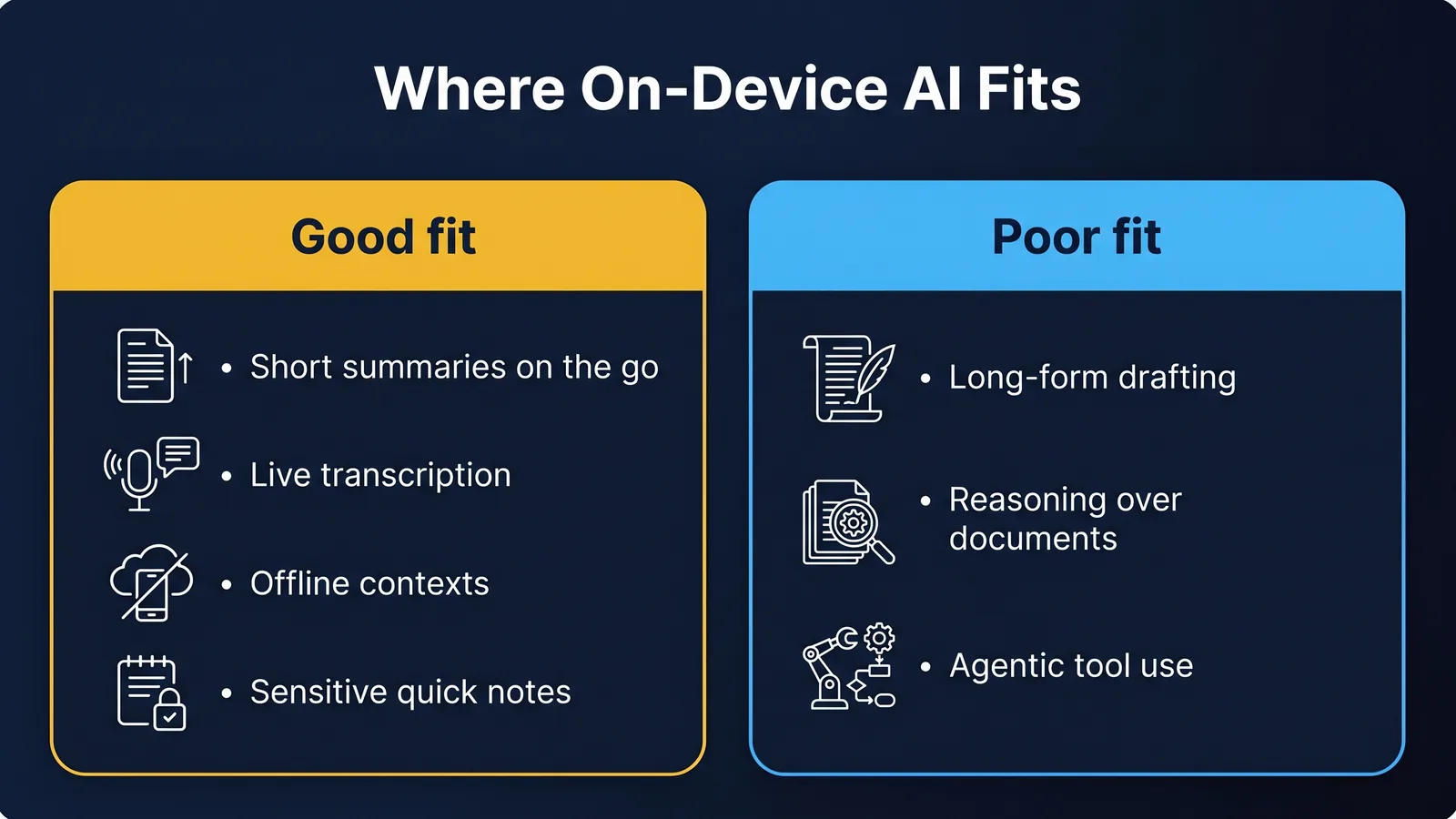
Where it does fit:
- Short summarisation on the go. Email summaries, message previews, voice memo transcriptions. On-device handles these well, fast, with no data leaving the device.
- Live transcription and translation. Pixel Gemini Nano is genuinely strong here, including multilingual transcription that runs entirely offline.
- Offline contexts. Field workers, travel, secure facilities. On-device AI works where there is no network.
- High-sensitivity quick tasks. A claims officer wanting to draft a 200-word internal note about a sensitive matter without sending the content to any cloud. On-device is the only credible answer.
Where it does not fit:
- Long-form drafting. The capability gap is too large.
- Reasoning over documents. On-device context windows are short and the models do not handle structured reasoning at the level of frontier cloud models.
- Tool use and agentic workflows. Both vendors are working on it. Neither is production-ready.
The privacy story has substance. Apple's Private Cloud Compute model is genuinely the strongest cloud privacy story in market. Google's on-device-only mode is enforceable through MDM. Both are auditable in ways that opaque cloud APIs are not.
The MDM story is also real but uneven. Apple's enterprise controls cover model selection, cloud escalation, and analytics opt-out at the policy level. Google's controls are similar in scope but the rollout to Workspace customers has been slower. As of April 2026, large enterprises on Google Workspace are reporting incomplete coverage of Pixel-specific controls in their existing MDM stacks.
What this means for regulated workplaces
For APRA-regulated entities, financial services and Comcare-aligned workers comp teams, on-device AI is the first credible answer to the data-residency conversation that has stalled enterprise rollouts for two years. Three concrete consequences. First, sensitive draft work that cannot leave the device now has a real tool. A case manager can summarise a sensitive meeting note or extract action items from a voice recording without any cloud transit. Second, CPS 234 and APP 11 conversations get easier when the model never leaves the managed device. The third-party processor question changes shape if there is no third-party processor in the on-device pathway. Third, the audit trail tightens. On-device inference logs to the device, not to a vendor pipeline. Forensic reconstruction is local.
There are limits worth naming. On-device models still hallucinate. Privacy on the inference path does not equal accuracy on the output. The HITL review gate that applies to any AI-assisted regulated workflow applies just as firmly to on-device output. Privacy gains do not lower the verification bar.
The procurement and MDM checklist
Five things to verify before treating on-device AI as a deployable enterprise tool. First, MDM coverage. Confirm your MDM (Jamf, Intune, Workspace, etc) supports on-device-only enforcement on the model and OS version your fleet is on, not just the marketing version. Coverage gaps remain common as of April 2026. Second, model-selection policy. Decide and enforce which on-device features (Writing Tools, Notification Summaries, Image Playground, Live Transcribe) are allowed for your workforce. Default-on at the OS level is not the same as policy-on at the org level. Third, escalation behaviour. Audit what triggers a Private Cloud Compute escalation on Apple, or a Gemini cloud handoff on Pixel, and confirm those escalations sit inside your residency posture. Fourth, retention and analytics. Both vendors expose granular opt-outs at the MDM level. Use them. Fifth, training-data warranties. Both vendors warrant on-device output is not used to train future models. Get the warranty in your contract, not just in the marketing.
Bottom line
- On-device AI is enterprise-ready for short, sensitive or offline tasks. It is not ready as a general productivity replacement.
- Apple Intelligence with Private Cloud Compute is the strongest cloud-privacy story currently available. For organisations whose privacy concerns are first-order, this is now a credible enterprise answer.
- Pixel Gemini Nano leads on transcription and translation. For field-based or multilingual workflows, this is the strongest on-device proposition.
- MDM controls are real but not universal. Verify coverage in your specific MDM stack before assuming you can enforce on-device-only mode at scale.
- Privacy gains do not relax the human-in-the-loop verification gate. On-device output still hallucinates and still needs review on regulated tasks.
- Treat on-device AI as a tier in your AI architecture, not a replacement for cloud models. Most knowledge workers will use both.
The right question is not "on-device or cloud". It is "which tasks belong on which tier, and is your MDM able to enforce the routing".
TheAICommand. Intelligence, At Your Command.